Understanding the Concept of Data Management Cloud
Posted July 21, 2023

We are encouraged to have a data management strategy because we could be welcoming damaging risks into our businesses without it. Much business data is unstructured and thus highly prone to security breaches. Data security posture management (DSPM) is a must for organizations. That is why we must consider the option of cloud data management.
Undoubtedly, firms have increasingly found data management on the cloud vital. When looking at the cloud data management system, we can note how, for instance, its high agility is beneficial to manage organizational data. More and more firms will take up cloud data management as they shift their operations online.
What is cloud data management?
Cloud data management can be loosely defined as managing data on the cloud. It implies implementing policies and procedures that grant firms control over their data on the cloud, multiple clouds, or on-premises that rely on cloud-based solutions.
Why is cloud data management important
In trying to understand cloud data management, we may also wonder why it is so important to businesses today. Well, many businesses realize each time that data management on the cloud is essential. It streamlines operations and allows for value extraction from data in a centralized point. Besides, cloud data management eliminates silos, enhances data security, and simplifies operations. With cloud data management, organizations can store their data without the need to invest in expensive infrastructure, hardware, and software. Cloud data management further makes access to data from anywhere possible for the firm’s convenience.
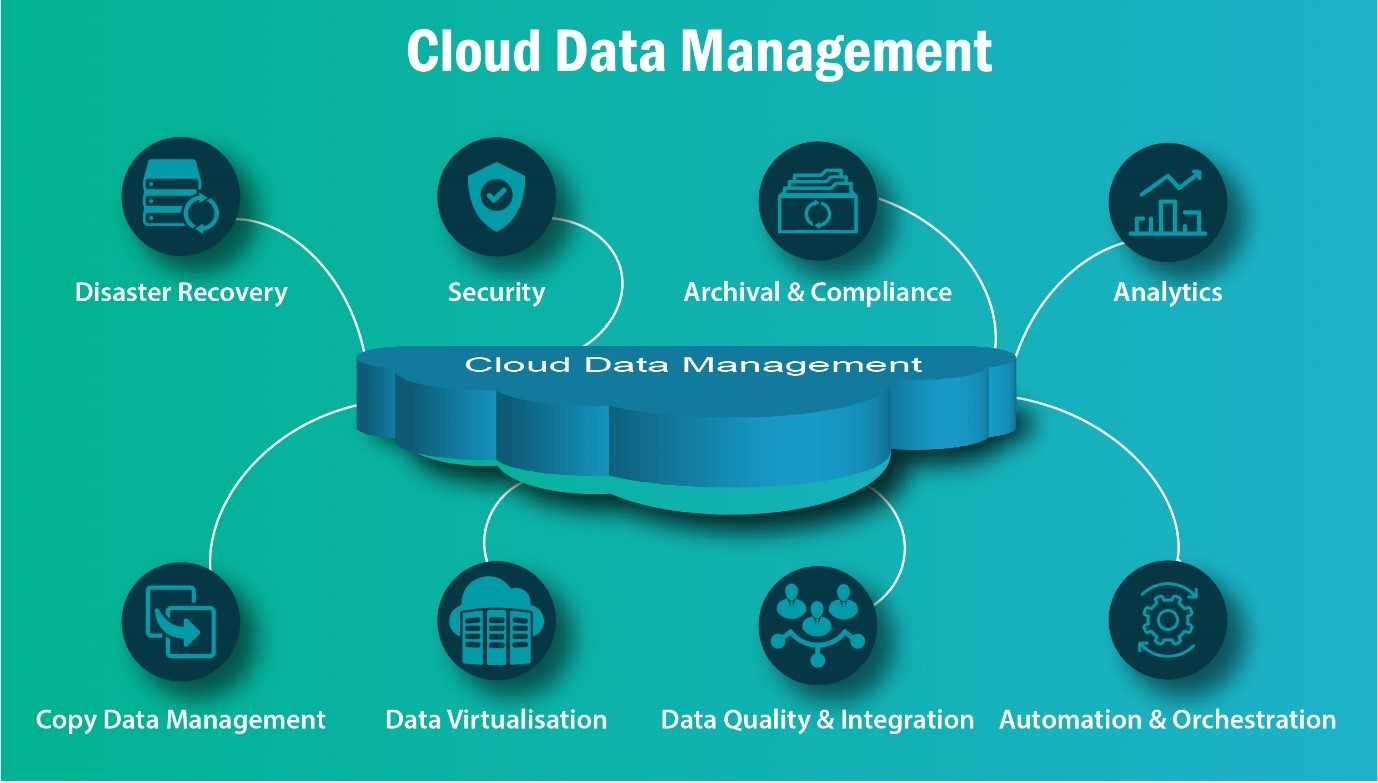
The pillars of cloud database management
Since we want to understand more about cloud database management, let us have a look at some of the major pillars onto which it is anchored:
- Protected storage
Whenever data is not up for processing or translation, the cloud stores it. The cloud ensures its security by guaranteeing firewall protection, which monitors website traffic. We can also store data on the cloud in an encrypted form. Such data will only appear as an unrecognizable code,, ensuring that only the intended users access it.
- Securing data movement
Firewalls and virtual private networks ensure that data on the cloud moves from one user to another safely. When running cloud data management for our organizations, one fear we might have is the risk of the data landing in the wrong hands when in transit. But cloud data management has measures to prevent unauthorised access from reading the data.
- Controlling data access
It is important that employees or the management of a business organization access data conveniently. But even so, there should be some limitations to data access to protect it from landing in the wrong hands. As business owners, we would not want just anyone to access all the detailed data. So, through the cloud database management system, we can enforce the limitations by granting access privileges to specific individuals in the firm.
- Authenticating arriving data
It is critical to check data for integrity once it arrives. The vetting rules out the possibility of transmitting data that is infected or which has been breached in any other way. Cloud database management provides a cloud-based authentication system that ensures data is vetted appropriately before being sent to the next user.
- Backup and recovery of data.
The other four pillars we have looked at are primarily focused on enduring data security. But even when data is protected from unauthorized alterations, it is still vulnerable to erasure. The cloud database allows for consistent regular backups of data, such that it can be recovered when lost. We must ensure that firms shave mechanisms to consistently back up data to the cloud.
How to use cloud data management
Now that we have understood the importance of cloud data management and seen some of its capabilities, how can we use it?
- Marketing purposes
Cloud data becomes critical to successful marketing campaigns when running a business firm. In such a moment, we can leverage cloud data to understand the relevant audience better. The organization can know the needs of its target population segment and whether the audience perceives its campaign efforts as effective. Using cloud data, the organization further understands what kind of data generates most engagements. Knowing all these insights, we get well-prepared when rolling out new campaigns. We remain dynamic by varying the processes and content of various campaigns to become more aligned with the targeted audience’s needs.
- Sales
The more we can understand our clients and their needs, the better we will sell them what they want. In the contemporary world, clients want their products and services tailored to their needs. But this also means that businesses and organizations must dig deep to assess and determine their target audience’s needs. Cloud data management makes that possible. It contains the most up-to-date data regarding market dynamics. These include the existing market gaps and statistics, such as sales metrics. It is now easy to keep track of the client’s purchase behaviour. Businesses provide consumers with the right product tailored to meet their needs. Doing so enhances sales as customers feel their needs are being met.
- Customer support
This is another area that cloud management helps us cover. In experience with organizations, we realize that one of the most critical aspects of operations is pleasing clients. No business wants to have negative customer reviews because that signals a downward direction in retaining users and conversion rates.
Cloud data management gives firms scalability to customer experiences without compromising the quality of services. It is easy to access customer profiles to provide timely assistance and feedback. The process is personalized at each step to enhance the client experience and encourage repeat purchases.
How is database management done in the cloud?
The cloud database management system uses various styles to manage data, as follows:
- Self-managed cloud database management system - this model allows total control to the organization in managing the database. The organization’s cloud database is executed on cloud infrastructure but still relies on in-house resources. The cloud vendor integrates no automation. The model enhances agility and flexibility as the organization exclusively determines how its database runs.
- Automated cloud database management system - as shown in the name, this model integrates automation in its operations. Here, firms rely on application programming interfaces to create lifecycle operations. Besides, consumers enjoy access to servers hosting the database.
- Managed cloud databases - they have a model similar to that of automated cloud database management systems. But in this case, consumer access to the servers that host the database is limited. Since users are not allowed to install their own software, the configuration remains that of cloud vendor-supported configurations.
- Autonomous cloud databases - this is a model where automation and machine learning have completely replaced human labour in managing the cloud database performance.
An example of data management
We have several examples of the real-world practice of data management systems. One example is Chameleon, a platform that manually tracks events using Google Sheets. Noting that they constantly experienced data inaccuracies and out-of-date, they adopted the tool- Iteratively. Integrating the tool into their analytics stack built a strong data management system that ensured confirmation and validation of events within their product.
Instacart, a grocery delivery service, is another example. It struggled for a while due to the challenges of data inefficiency. Handling the large amount of data they were receiving also proved to be more challenging. Eventually, they adopted Amplitude to help handle their growing load of data. With the data management system set, Instacart could now focus on product improvements.
Cloud storage and data management for cloud storage
Cloud storage refers to a computing model that allows storing files on the internet by relying on a cloud computing provider. Such data becomes accessible through either a private network connection or a public network, like the internet. Cloud storage is such that it eliminates the need to purchase and manage own data storage infrastructure.
Data management for cloud storage is how an organization manages data across cloud platforms. These platforms can be cloud, multiple clouds, or on-premises that rely on cloud-based solutions.
Challenges of cloud data management
Let us take a look at some of the challenges that come with using cloud data management:
- It is time-consuming - many firms must adopt several technologies that support each cloud connection. Setting up these configurations takes a lot of time.
- Downtimes - unfortunately, the reliance on the internet by cloud-based solutions means that weak internet signals interrupt cloud data management.
- Unreliability - cloud data management systems are unreliable because of changing business requirements. This forces businesses to seek further computing resources to help facilitate compatibility with the existing cloud data management system. Besides, the data can be compromised if a cloud vendor is hacked.
- Data security and privacy issues - security and privacy in data management are sensitive issues pertaining to cloud storage systems. Not all cloud providers can guarantee 100% data privacy. Misconfigurations when setting up the cloud data management system can compromise data privacy. Besides, malicious insiders and insecure application programming interfaces can result in data security issues.
- Data migration to the cloud is a challenge because it takes time, and many firms are often unprepared for it. Migrating data to the cloud often comes with increasing downtimes, security breaches, and privacy leaks. The process ends up being more expensive and engaging resource-wise than was foreseen.
The benefits of cloud data management
- Data backup - cloud storage ensures data can be secured externally on the internet. This external storage ensures that company data is preserved in case of unprecedented data loss on-premise. Such data can be retrieved through recovery, ensuring the firm’s activities function well.
- Data security - one of the challenges with internet use is data breaches due to hacking or attack by malware. Moving data to the cloud can enhance its security because there are firewalls that help regulate data traffic on the cloud. Besides, data is stored here in encrypted form across several platforms. Even if one of the platforms is compromised, the organization’s data remains safe.
- Scalability - with cloud storage, an organization does not have to worry about lacking adequate space for new files or software updates. The cloud allows for high levels of scalability. Thus, we can still access all the needed information from the cloud without experiencing any limitations.
- Data progression- the cloud is always up-to-date. It ensures that an organization’s data management system will enjoy all the new functions as soon as they are made available.
- Data sharing - cloud data management ensures that data flow from one user to another is secure. It eliminates the risk of data being intercepted by unauthorized personnel.
- Accessibility - thanks to cloud data management systems, it is now very easy for us to access our data from any point provided by an internet connection. This is such an important part of business organizations, especially now that the idea of remote working has been on the rise.
Conclusion
Cloud data management is critical for business organizations. There is no denying that it has its own demerits, such as being time-costly, having downtimes, and experiencing data security risks. But we cannot take away from its advantages, including enhanced data security, high scalability, data backup and recovery capabilities, and improved data accessibility.
Cloud data storage management is how business and non-business firms seek to control their data better. Utilizing this system will ensure data is handled in ways that help create value for the organization.

Written By:
Abiola Isabella
More Related Articles:
-

Understanding the Concept Cloud Managed Data Center Services
Managing an organization’s data can be costly and time-consuming, and there are so many security risks and vulnerabilities to consider while
Jul 21, 2023
-

Understanding the Concept of Google Cloud Identity Platform
The power of identity platforms (IdP) from the cloud has created reliable and sustainable IDaaS Vendors. The Google Cloud Identity Platform (GCP) is
Jul 21, 2023